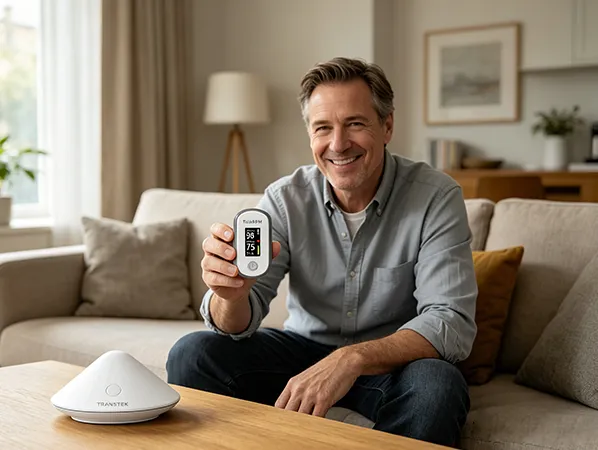
Bluetooth pulse oximeters are increasingly used in Remote Patient Monitoring (RPM) programs, but their value depends on more than wireless measurement capability. While these devices can accurately measure SpO₂ and pulse rate, the overall monitoring experience may become challenging if patients are required to repeatedly pair devices, use mobile applications, or manually confirm measurement transmission.
For home monitoring programs to operate effectively, the workflow needs to be simple for patients and manageable for healthcare providers. A well-designed Bluetooth RPM solution should not only support accurate measurement but also provide a reliable connection pathway between the patient’s home and the care team.
In Transtek’s RPM device ecosystem, Bluetooth pulse oximeter deployment follows a hub-centered workflow. Instead of requiring patients to manage smartphone-based applications, the process focuses on four key steps: home measurement, Bluetooth connection through AnyHub, measurement transmission, and clinical review through the Device Management Dashboard.
This approach allows Bluetooth medical devices to support RPM programs while reducing technical complexity for patients, especially elderly users, post-discharge patients, and individuals with limited digital experience.
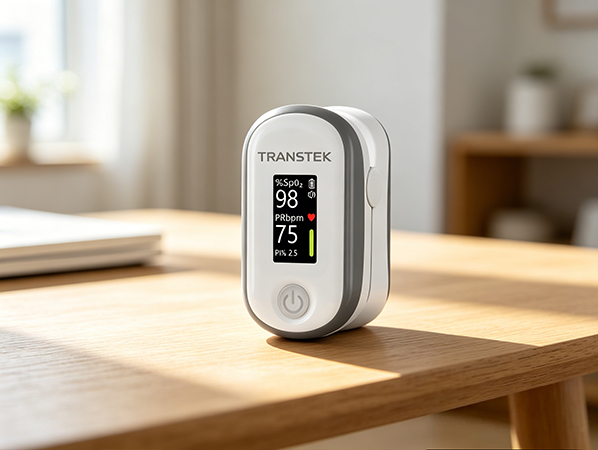
A Bluetooth pulse oximeter is compact, convenient, and suitable for home respiratory monitoring. However, Bluetooth connectivity alone does not guarantee a smooth RPM experience.
In some consumer-focused workflows, patients may need to download an application, complete Bluetooth pairing, keep a smartphone nearby, approve permissions, and confirm whether measurements have been successfully transmitted. While these steps may be acceptable for experienced smartphone users, they can become barriers for elderly patients or individuals managing chronic conditions at home.
Common challenges include:
Forgotten application passwords
Bluetooth pairing failures
Incompatible smartphones
Unstable wireless connections
Uncertainty about whether measurements were successfully transmitted
When these issues occur repeatedly, patients may lose confidence in the monitoring process. At the same time, healthcare providers and care coordinators may spend additional time troubleshooting technical issues instead of focusing on patient monitoring.
A successful Bluetooth RPM solution should therefore consider the complete monitoring workflow, not only the wireless connection. The key questions include:
What actions are required from the patient after measurement?
How does the device connect to the RPM system?
How can healthcare providers confirm that measurements are available for review?
By addressing these workflow challenges, Bluetooth pulse oximeters can become easier to deploy and maintain in real-world home care environments.
In a hub-centered RPM workflow, the patient’s role remains simple. The patient measures SpO₂ and pulse rate at home using the Bluetooth pulse oximeter. The device then connects to AnyHub through Bluetooth, allowing measurements to be transmitted through the connected RPM environment.
Unlike app-only Bluetooth models, this approach reduces the need for patients to manage repeated smartphone operations. The purpose of the hub is not to add another technical step, but to create a more practical connection pathway between medical devices and RPM workflows.
A simplified Bluetooth RPM workflow may include:
The patient measures SpO₂ and pulse rate at home.
The Bluetooth pulse oximeter connects with AnyHub.
Measurements are transmitted through AnyHub with cellular connectivity.
The Device Management Dashboard organizes measurement availability and device status.
Healthcare providers review readings and trends as part of ongoing monitoring.
This structure helps reduce patient-side complexity while giving RPM teams better visibility into device operation. It also makes Bluetooth medical devices more practical for programs that require remote monitoring without asking patients to manage complicated digital workflows.
For small-scale monitoring programs, healthcare teams may manually confirm whether patients are using devices correctly. However, as RPM programs expand, manual management becomes increasingly difficult.
Healthcare providers need visibility into whether devices remain connected, whether patients are completing measurements regularly, and whether missing readings are related to device usage, connectivity conditions, or battery status.
A hub-centered Bluetooth pulse oximeter workflow helps address these challenges by supporting device status visibility through the Device Management Dashboard. Instead of relying only on patient feedback, RPM teams can better understand whether technical issues are affecting measurement availability.
This improves operational efficiency. Missing measurements are no longer only a blank record; they provide an opportunity for teams to investigate possible causes and provide appropriate follow-up.
When device status, measurement history, and connectivity performance can be reviewed more efficiently, healthcare providers can manage larger patient populations with greater confidence.
Pulse oximeters measure blood oxygen saturation (SpO₂) and pulse rate, two important indicators in home respiratory monitoring. While a single reading reflects a patient’s condition at one specific moment, repeated measurements over time can help healthcare providers better understand changes in respiratory status.
A Bluetooth pulse oximeter can support various RPM scenarios, including chronic respiratory disease management, post-discharge monitoring, senior care programs, and home-based respiratory follow-up.
The value of connected monitoring comes from consistent measurement collection and organized review. For example, one SpO₂ reading may show oxygen saturation at a specific time, while measurement trends can provide additional insight into whether a patient’s respiratory condition remains stable or changes over time.
For patients, the device should remain simple and comfortable to use. For healthcare providers, measurements should be easy to access and review. When Bluetooth pulse oximeters are integrated into an RPM workflow through AnyHub, care teams can monitor trends, identify missing readings, and determine when additional follow-up may be appropriate.
A common challenge in digital health programs is requiring patients to complete technical tasks beyond the actual measurement process. A patient may be willing to check oxygen saturation regularly but may struggle with smartphone setup, Bluetooth pairing, or application management.
A hub-centered Bluetooth SpO₂ monitoring workflow helps reduce these barriers. Patients focus on completing the measurement, while AnyHub supports device connectivity and measurement transmission within the RPM system.
This approach is particularly valuable for:
Elderly patients with limited digital experience
Patients recovering at home after hospitalization
Chronic disease populations requiring long-term monitoring
RPM programs where caregivers or healthcare teams support home care management
Reducing technical complexity can also improve patient onboarding. When patients do not need to repeatedly download applications or manually pair devices, the monitoring process becomes easier to explain, easier to complete, and easier to maintain over time.
For healthcare providers, a simplified workflow can reduce operational challenges while supporting more consistent participation across different patient groups.
When selecting a Bluetooth pulse oximeter for RPM programs, healthcare providers should evaluate more than device size and wireless connectivity. A successful solution should support both patient usability and efficient program management.
Important factors to consider include:
Simple operation
Clear and easy-to-read display
Comfortable finger design
Reliable Bluetooth connectivity
Accurate SpO₂ measurement
Compatibility with AnyHub or gateway solutions
Device Management Dashboard integration
Battery status visibility
Ease of deployment across different patient populations
For elderly users, intuitive operation and clear displays can reduce confusion during daily monitoring. For healthcare providers, stable connectivity and device visibility can simplify workflow management and reduce unnecessary technical support.
The role of the hub should also be carefully considered. If every patient must download applications and manually complete device pairing, RPM programs may require additional training and ongoing assistance. A hub-centered Bluetooth workflow can provide a more standardized approach that supports easier deployment and scalability.
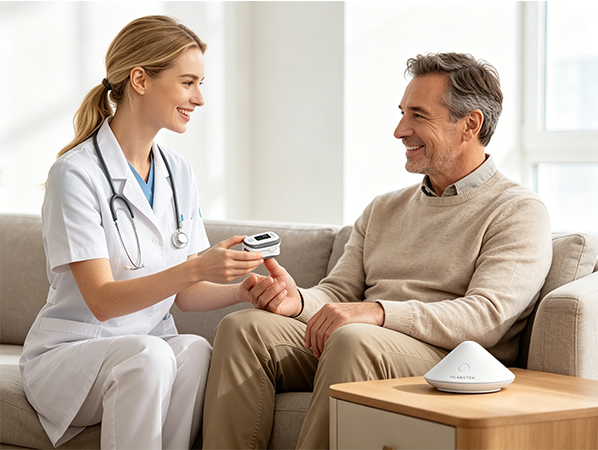
The Transtek Bluetooth® Pulse Oximeter is designed for home respiratory monitoring scenarios where simple operation, reliable connectivity, and efficient RPM workflows are important.
Rather than requiring patients to connect monitoring devices through personal smartphones or home Wi-Fi networks, AnyHub automatically receives measurements from compatible Bluetooth® Pulse Oximeter and transfers them through built-in cellular connectivity.
The device features a 0.96-inch rotating TFT display, one-button operation, auto switch-off, silicone finger mold, lightweight portability, and SpO₂ measurement accuracy of ±2% within the 70%–100% measurement range.
By combining Bluetooth medical device connectivity with AnyHub-based deployment, Transtek helps healthcare providers build more scalable respiratory monitoring programs that reduce patient complexity and improve operational efficiency.
Bluetooth pulse oximeters provide an effective approach for extending respiratory monitoring beyond traditional healthcare settings. However, the success of Bluetooth RPM programs depends not only on device measurement capability but also on creating a simple and reliable workflow.
For RPM programs serving elderly patients, post-discharge populations, and chronic respiratory care groups, a hub-centered Bluetooth solution provides a practical balance between patient usability and healthcare provider efficiency.
With Bluetooth connectivity, AnyHub integration, and user-friendly design, Transtek Bluetooth® Pulse Oximeter supports scalable home respiratory monitoring solutions designed for real-world healthcare environments.
+86-0760-88282982