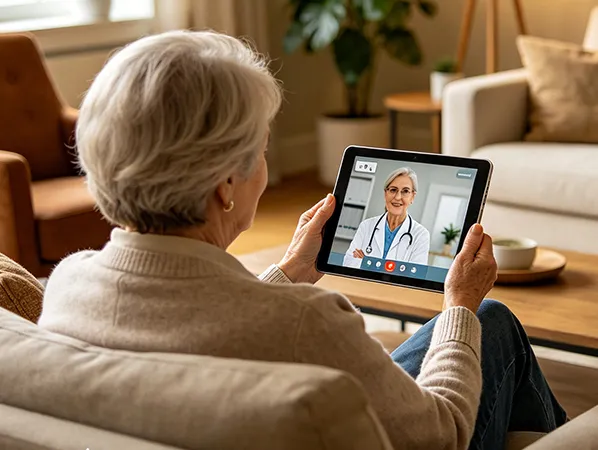
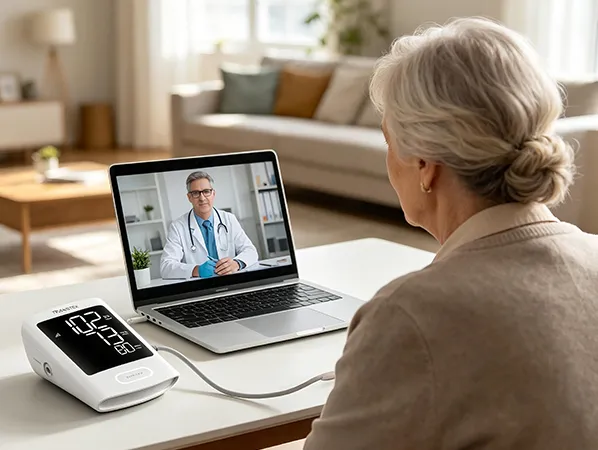
Scaling a Remote Patient Monitoring (RPM) program requires more than adding connected medical devices. As patient volume grows, healthcare providers and RPM service providers must manage device deployment, patient onboarding, connectivity, measurement transmission, technical support, and device lifecycle management across an increasingly distributed population.
Bluetooth medical devices can provide a flexible foundation for multi-device RPM programs. However, the key to scalability is not Bluetooth connectivity alone. It is how Bluetooth devices are connected, managed, and integrated into the broader RPM workflow.
A Bluetooth medical device + dedicated gateway can create a structured connection between the patient's devices and the healthcare platform while reducing reliance on the patient's personal smartphone.
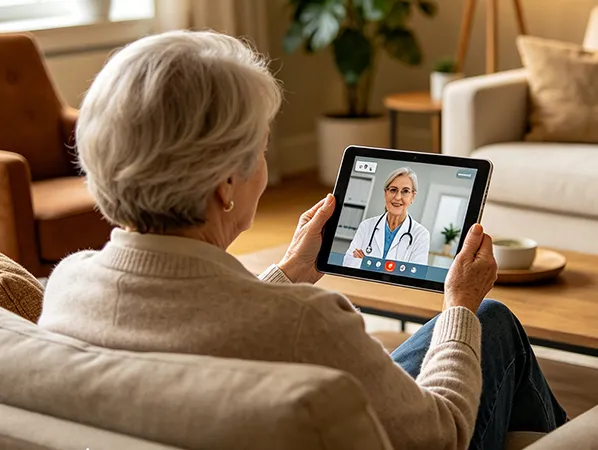
RPM programs often require more than one type of measurement. A patient may use a blood pressure monitor, weight scale, pulse oximeter, or blood glucose meter depending on the monitoring program.
Using Bluetooth as the device-side connectivity layer allows different medical devices to communicate through a common gateway architecture.
For healthcare providers, this creates an opportunity to build a device portfolio rather than designing a separate connectivity workflow for every device.
The value is particularly relevant when programs need to:
Support multiple medical device categories
Equip patients with several devices
Standardize device deployment
Reduce smartphone dependency
The gateway is what turns a collection of Bluetooth medical devices into a more manageable RPM programs.
A typical workflow is:
Bluetooth Medical Devices → AnyHub → Device Management Dashboard
Medical devices communicate with AnyHub through Bluetooth. AnyHub then uses cellular connectivity to transmit measurements to the Device Management Dashboard.
Patients can use Bluetooth medical devices without relying on their own smartphone or managing an RPM application for measurement transmission. At the same time, the RPM operator has a dedicated connectivity component that can be deployed and managed as part of the program.
This is particularly useful for healthcare providers that want to provide multiple connected devices while keeping the patient-side workflow straightforward.
Patient usability should be considered at the architecture level.
A Bluetooth RPM workflow that requires patients to install applications, manage pairing, troubleshoot smartphone compatibility, and manually transmit measurements can create unnecessary operational friction.
A dedicated gateway can move much of this connectivity complexity away from the patient.
The desired workflow is straightforward:
Use the medical device → Complete the measurement → Bluetooth transmission to gateway → Cellular transmission to the platform
This does not eliminate every possible onboarding or support requirement, but it can reduce the number of connectivity tasks patients need to perform themselves.
For programs serving older adults or patients with different levels of digital experience, reducing these dependencies can make device onboarding and routine measurement easier to manage.
AnyHub provides a centralized gateway architecture that allows multiple Bluetooth medical devices to connect through one gateway. Blood pressure monitors, blood glucose meters, weight scales, and pulse oximeters can be combined according to the requirements of the monitoring program.
This enables healthcare healthcare providers and RPM service providers to support multi-condition monitoring through a unified connectivity setup, rather than deploying a separate transmission solution for each device.
For healthcare provider, the benefit extends beyond connectivity. A centralized gateway can simplify device deployment, reduce the number of connectivity components that need to be managed at the patient side, and make it easier to expand from a single-condition program to broader RPM configurations.
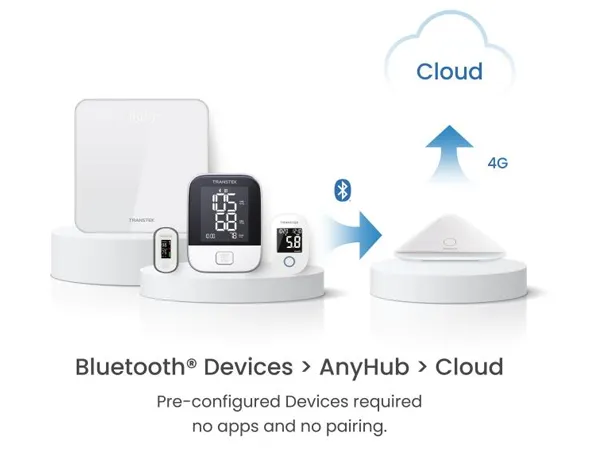
Transtek is designed to help healthcare providers scale beyond single-device monitoring without creating a separate connectivity workflow for every medical device. Its Bluetooth medical device portfolio covers blood pressure, blood glucose, weight, and SpO₂ monitoring, while TeleRPM AnyHub serves as a centralized cellular gateway for multiple Bluetooth devices.
This architecture allows different devices to be configured around the needs of each RPM program while keeping the connectivity setup at the patient side more manageable. Instead of requiring each device to have its own transmission method, multiple Bluetooth devices can communicate through a single gateway, supporting multi-condition monitoring within one deployment model.
More importantly, Transtek approaches Bluetooth RPM programs as an operational architecture—not simply a collection of connected devices. By combining a multi-device Bluetooth ecosystem with a dedicated gateway, the solution is built to support the practical demands of device deployment, patient onboarding, program expansion, and ongoing device operations at scale.
Building a scalable RPM program with Bluetooth medical devices requires more than connecting devices wirelessly. The real value comes from creating a structured architecture for device connectivity, gateway management, measurement transmission, platform integration, and device lifecycle management.
With Bluetooth medical devices connected through a dedicated gateway such as AnyHub, healthcare providers can support multi-device RPM programs while reducing unnecessary patient-side connectivity tasks.
For healthcare providers, the goal is not simply to deploy more connected devices. It is to create an RPM infrastructure that can deploy efficiently, operate systematically, and scale with the program.
Bluetooth medical devices can transmit measurements to a dedicated gateway such as AnyHub. AnyHub then uses cellular connectivity to transmit those measurements to the Device Management Dashboard, creating a structured connection between patient-side devices and the RPM platform.
A dedicated gateway can provide a centralized connectivity layer for multiple Bluetooth medical devices. It can also reduce reliance on patients' personal smartphones and help standardize the transmission architecture across a multi-device RPM program.
Yes, a gateway-based architecture can be designed to support multiple Bluetooth medical devices, depending on the gateway's technical specifications and deployment configuration. This makes the architecture suitable for RPM programs that require multiple types of physiological measurements.
Scalability depends on more than Bluetooth connectivity. healthcare providers should establish repeatable processes for device provisioning, patient-device association, deployment tracking, connectivity monitoring, technical support, replacement, and device lifecycle management.
Key considerations include measurement performance, patient usability, connectivity architecture, gateway compatibility, device management capabilities, platform integration, and the ability to support the organization's expected deployment volume.
+86-0760-88282982